A new roof is one of the biggest checks most homeowners ever write for their house, and it almost never arrives at a convenient time. The good news is that you have more choices than you might think. In this guide, we break down 17 ways to finance your roof, from contractor payment plans to government loans, grants, and insurance.
If you own a home in Peoria or anywhere in Central Illinois, you already know how hard our weather is on roofs. One brutal winter or one hail storm can turn a "maybe next year" roof into an urgent project. If water is coming in right now, call us about emergency roof repair first, then come back to this guide.
For each option, we explain how it works, who it fits best, and what to watch out for. That way you can choose with confidence instead of pressure.
The best way to finance a roof is not the one that sounds cheapest. It is the one that fits your budget, your timeline, and your comfort with risk.

What a New Roof Really Costs (and Why Financing Is So Common)
National cost guides put a typical roof replacement at around $10,000. The full range is wide, from roughly $6,000 to well over $40,000. Your number depends on a handful of factors:
- Roof size: more square footage means more materials and labor.
- Pitch and complexity: steep roofs, valleys, and skylights take longer.
- Materials: asphalt shingles, metal, and other options vary a lot in price.
- Tear-off and disposal: removing old layers adds to the total.
- Decking repairs: rotted or damaged boards found during tear-off must be replaced.
- Flashing, vents, and permits: the small details that keep water out.
Because a full roof replacement is usually unplanned, many homeowners cannot pay in cash without draining their savings. That is why financing is so common, and why it pays to compare your options before you sign anything.
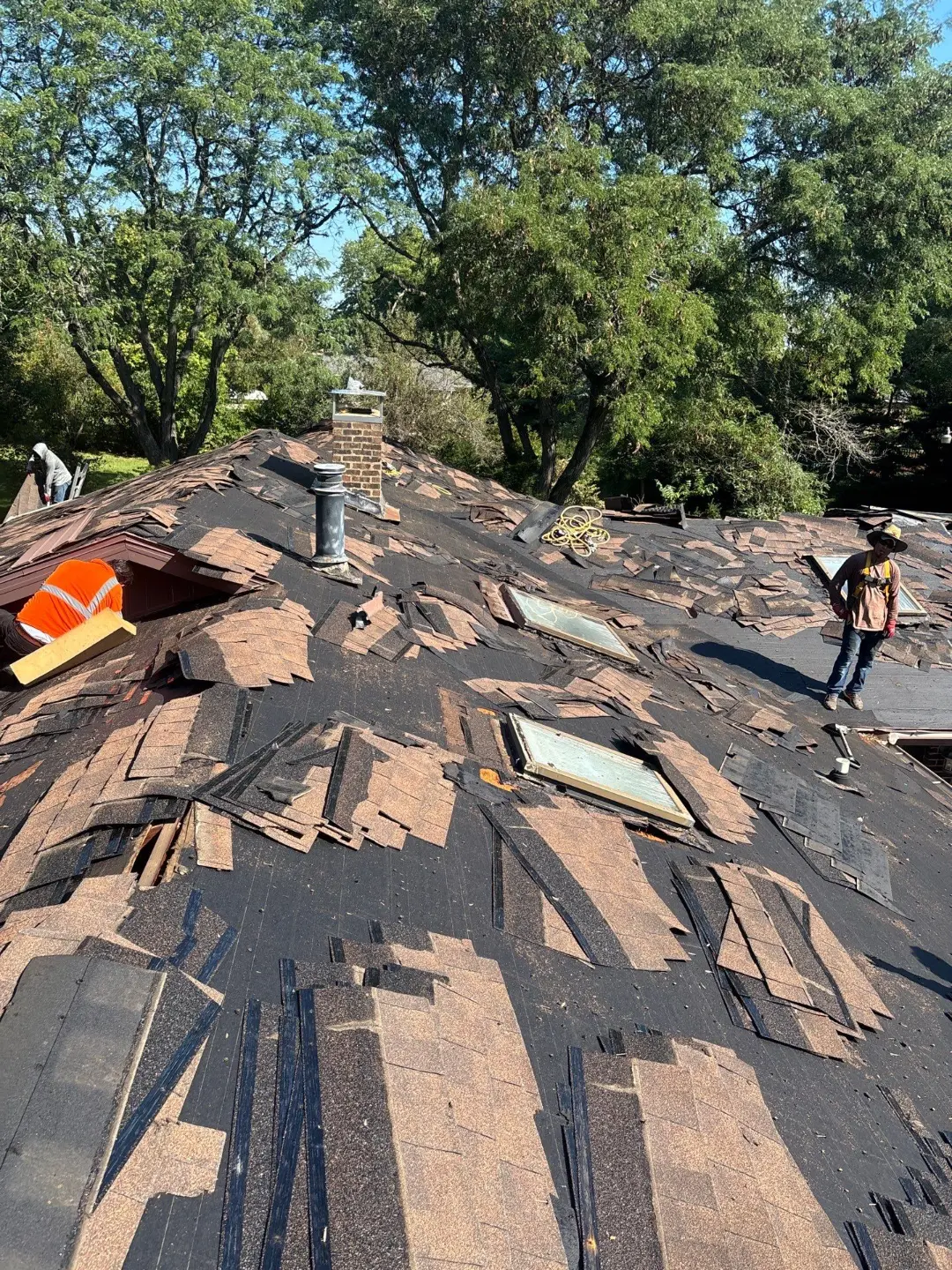
A roof also protects everything underneath it: your ceilings, insulation, walls, and belongings. Delaying a needed replacement often costs more in the long run, because small leaks tend to turn into rot, mold, and interior repairs.
One reality check before the list: financing does not make a roof cheaper. It spreads the cost over time. Your goal is to keep the total cost, including interest and fees, as low as possible.
Always get at least two written estimates, then compare the financing terms side by side, not just the monthly payment.
Fast and Simple Ways to Pay for a Roof
These three options are the most common starting points, and they are often the quickest to arrange.
1. Roofing Contractor Financing
Many roofing companies offer financing through lending partners, so you can apply and sign your roofing contract in one place. At Rainforcing Roofing & Exteriors, we partner with GoodLeap. You can learn more and get started on our roof financing page.
Approval, rates, and terms depend on your credit and the lender's program. Read the full agreement, including the APR, the length of the loan, and any fees, before you accept.
Best for: homeowners who want one-stop convenience and a quick decision.
Watch for: promotional rates that change after an introductory period.
2. Your Homeowners Insurance Claim
If hail, wind, or a fallen tree damaged your roof, your homeowners policy may pay for part or all of the repair or replacement. This is not a loan. It is coverage you have already been paying for.
Most policies pay after you meet your deductible, and many have a separate, often higher, deductible for wind and hail. Policies also differ on whether they pay actual cash value or full replacement cost, so check your declarations page.
Age and normal wear are usually not covered, and claims often have filing deadlines. Document the damage early. You can learn how we help on our insurance claims page and our storm damage roof repair page.
Insurance covers sudden damage, like a storm. It generally does not cover a roof that simply wore out.

3. Savings and Cash
Paying cash is the cleanest option. There is no interest, no lender, and no fees. If you have the money, it is also the cheapest way to finance your roof, because there is nothing to finance.
Just do not empty your emergency fund. A new roof will not help if your furnace fails next month. A common rule of thumb is to keep three to six months of expenses in reserve before spending the rest.
If your roof is not leaking, you may be able to save for several months and schedule the work in a good season. Have a professional inspect it first, so you know how much time you really have.
Best for: homeowners with a healthy reserve and a roof that can wait.
Watch for: putting off work until a small problem becomes a big one.

Ways to Use Your Home Equity
If you have built up equity in your home, you can borrow against it, often at lower rates than credit cards or personal loans. The tradeoff is simple: your home is the collateral. Here is how the three main equity options compare.
| Feature | HELOC | Home Equity Loan | Cash-Out Refinance |
|---|---|---|---|
| How you get the money | Credit line you draw from as needed | One lump sum upfront | New, larger mortgage; you keep the difference |
| Interest rate | Usually variable | Usually fixed | Fixed or adjustable, applied to your whole mortgage |
| Payments | Often interest-only at first, then principal and interest | Fixed monthly payment | One new monthly mortgage payment |
| Closing costs | Often lower | Moderate | Usually the highest |
| Best when | Costs may change | You know the exact cost | You were refinancing anyway at a good rate |
4. Home Equity Line of Credit (HELOC)
A HELOC works like a credit card secured by your home. You get a limit, draw what you need, and pay interest only on what you use. That flexibility helps if your final roof cost is not certain.
Rates are usually variable, so your payment can rise over time. Many lenders let you borrow up to roughly 80% to 85% of your home's value, minus what you still owe on your mortgage.
Best for: homeowners with solid equity who want flexibility.
Watch for: variable rates, fees, and the risk to your home if you cannot pay.
5. Home Equity Loan
Often called a second mortgage, a home equity loan gives you a lump sum with a fixed rate and a fixed monthly payment. Predictable payments make budgeting easy.
You will pay closing costs, and the lender will usually appraise your home. If you already have a firm roofing estimate in hand, this can be a simple and stable choice.
Best for: a known project cost and a steady budget.
Watch for: closing costs and a longer approval process than contractor financing.
6. Cash-Out Refinance
With a cash-out refinance, you replace your current mortgage with a bigger one and take the difference in cash. It can make sense if today's rates are lower than your current rate, or if you were already planning to refinance.
If your current rate is lower than today's, the opposite is true. You could pay a higher rate on your entire balance, not just the roof money. Closing costs commonly run a few percent of the loan.
Best for: homeowners who would refinance anyway.
Watch for: giving up a low existing mortgage rate.
7. Reverse Mortgage (Homeowners 62+)
A Home Equity Conversion Mortgage (HECM) lets homeowners 62 and older turn equity into cash without a required monthly mortgage payment. Borrowers must still pay property taxes and insurance, maintain the home, and live in it as their primary residence.
HECMs require counseling from a HUD-approved counselor, and fees can be significant. Interest builds over time, so the balance grows. Talk it through with your family before deciding.
Best for: seniors with plenty of equity and limited monthly cash flow.
Watch for: fees, a growing balance, and the effect on heirs.
Government-Backed and Renovation Loans
Most government programs do not lend directly. They insure or back loans made by approved lenders, which can help homeowners with limited equity or lower credit scores qualify.
8. FHA Title I Property Improvement Loan
FHA Title I loans can pay for home improvements, including roofing. For a single-family home, the maximum is $25,000, with terms of up to 20 years. Loans above $7,500 must be secured by a recorded lien on the property.
Because the amount is capped, it fits repairs and smaller roofs better than a large, complex replacement. Only some lenders offer Title I loans, so you may need to ask around.
Best for: smaller projects when equity is limited.
Watch for: the $25,000 cap and limited lender availability.
9. FHA 203(k) Renovation Loan
A 203(k) rolls renovation costs into one FHA mortgage when you buy or refinance a home. The Limited 203(k) covers non-structural work, such as a new roof, up to $75,000. The Standard 203(k) is for larger projects of $5,000 or more.
Minimum credit scores are 580 with 3.5% down, or 500 with 10% down, though many lenders ask for more. The home must be your residence, and work generally has to be done by licensed contractors on a set timeline.
Best for: buyers and refinancers who need repairs built into the loan.
Watch for: extra paperwork and deadlines.
10. Fannie Mae HomeStyle and Freddie Mac CHOICERenovation
These conventional renovation mortgages let you finance a home purchase or refinance along with the cost of repairs, all in a single loan. Roofing is a common use. They can be a good fit if you have solid credit and do not need FHA flexibility.
Expect more paperwork than a standard mortgage: contractor bids, an appraisal based on the finished value, and staged payments to the contractor.
Best for: buyers and refinancers with good credit.
Watch for: a longer closing process.
11. USDA Section 504 Home Repair Loans and Grants
USDA offers repair loans of up to $40,000 at a fixed 1% interest rate over 20 years. It also offers grants of up to $10,000 for homeowners 62 and older with very low incomes. Funds can be used for repairs, including roofing.
The home must be in an eligible rural area, and your income must fall within county limits. The city of Peoria is unlikely to qualify, but some smaller communities and rural areas around it may. Check USDA's eligibility map or call your local Rural Development office.
Best for: low-income homeowners in eligible rural areas.
Watch for: strict eligibility rules and slower processing.

Grants and Community Programs
If your household income is limited, you may not have to borrow at all. Some programs offer repair grants, but funds are limited and waitlists are common.
12. Illinois Home Repair and Accessibility Program (HRAP)
The Illinois Housing Development Authority (IHDA) funds HRAP grants through local organizations. In the latest round we found announced (Round 2, October 2025), grants of up to $50,000 per homeowner were available to households at or below 80% of Area Median Income. There was also a roof-only option for homes without other major problems.
Applicants must own a single-family home and be current on their mortgage. The City of Peoria and METEC, which serves Peoria County, were among the local grantees. Funding rounds change, so contact them directly to confirm what is open now.
Best for: income-qualified homeowners in Peoria and Peoria County.
Watch for: waitlists and limited funding.
13. Nonprofits and Local Assistance
Housing nonprofits, such as Habitat for Humanity affiliates and Rebuilding Together chapters, along with your city or county housing office and your Area Agency on Aging, sometimes help low-income homeowners and seniors with urgent repairs, including roofs.
Dialing 2-1-1 is a quick way to find local services. Help is limited and often has eligibility rules, so apply early and keep a backup plan.
Best for: seniors, veterans, and low-income households facing urgent repairs.
Watch for: long waits and limited availability.
Personal Credit and Borrowing Options
If you do not have much equity, or you would rather not put your home on the line, these options may fit better. They usually move faster, but they can cost more.
14. Unsecured Personal Loan
A personal loan gives you a lump sum with fixed payments, usually over two to seven years, and it does not use your home as collateral. Funding can happen in days. Rates depend heavily on your credit and can run well above home equity rates.
Shop several lenders using prequalification, which usually involves a soft credit check. Compare the APR, not just the monthly payment, and watch for origination fees.
Best for: good credit, speed, and no collateral.
Watch for: higher interest rates and origination fees.
15. 0% Intro APR Credit Card
Some cards offer 0% interest for 12 to 21 months. If you can pay the balance before the promotion ends, this is close to free financing. But limits are often too low for a full roof, and the rate after the promotion can be steep.
Use it for a smaller repair, and only with a clear payoff plan. Check for balance transfer fees and the date the promotional rate ends.
Best for: small repairs you can pay off quickly.
Watch for: high rates once the promotion ends.
16. Loan From Family or Friends
A loan from someone you trust may come with low or no interest. It can also strain a relationship if expectations are unclear.
Put everything in writing: the amount, the interest, the payment schedule, and what happens if a payment is missed. A simple promissory note protects both sides.
Best for: strong relationships and a clear repayment plan.
Watch for: misunderstandings that damage the relationship.
17. 401(k) Loan (Last Resort)
Many plans let you borrow from your 401(k), generally up to the lesser of $50,000 or 50% of your vested balance, with repayment through payroll over about five years. You pay the interest back into your own account.
The risks are real. Your money is out of the market while you repay, and if you leave your job, the balance can come due quickly. Unpaid amounts can be treated as a taxable withdrawal, with possible penalties. Talk to a financial or tax professional before you choose this option.
Best for: emergencies, and only when nothing else works.
Watch for: lost growth, taxes, and penalties.
Side-by-Side Comparison of All 17 Options
Here is a quick reference you can scan. Timelines are typical estimates and vary by lender and program.
| Option | Best for | Uses your home as collateral? | Typical speed |
|---|---|---|---|
| 1. Contractor financing | Convenience and a fast decision | Depends on the program | Days |
| 2. Insurance claim | Sudden storm or hail damage | No | Weeks |
| 3. Savings and cash | A healthy reserve | No | Immediate |
| 4. HELOC | Costs that may change | Yes | 2 to 6 weeks |
| 5. Home equity loan | A known cost and fixed payment | Yes | 2 to 6 weeks |
| 6. Cash-out refinance | Refinancing anyway at a good rate | Yes | 30 to 60 days |
| 7. Reverse mortgage (62+) | Seniors with equity | Yes | 1 to 2+ months |
| 8. FHA Title I | Smaller projects | Yes, above $7,500 | Varies by lender |
| 9. FHA 203(k) | Buying or refinancing with repairs | Yes | 1 to 2+ months |
| 10. HomeStyle / CHOICERenovation | Buyers or refinancers with good credit | Yes | 1 to 2+ months |
| 11. USDA Section 504 | Low-income rural homeowners | Varies | Months |
| 12. Illinois HRAP | Income-qualified homeowners | No (grant) | Months, waitlists |
| 13. Nonprofits | Seniors and urgent repairs | No | Months, waitlists |
| 14. Personal loan | Good credit, no collateral | No | Days |
| 15. 0% APR card | Small repairs paid off fast | No | Days |
| 16. Family or friend loan | Strong relationships | No | Fast |
| 17. 401(k) loan | Last resort only | No, but retirement savings at risk | 1 to 2 weeks |
What Lenders Look For (and How to Improve Your Odds)
Whichever route you take, most lenders review the same handful of things:
- Credit score: higher scores generally unlock lower rates and better terms.
- Debt-to-income ratio: your monthly debt payments compared with your monthly income. Many lenders prefer to see it below about 43%.
- Home equity: for HELOCs, home equity loans, and refinances, the amount you owe compared with your home's value matters a lot.
- Income and employment history: expect to provide pay stubs, tax returns, or bank statements.
- The project itself: a written estimate from a licensed, insured roofing contractor.
A few simple steps can improve your odds before you apply:
- Pull your free credit reports and dispute any errors.
- Pay down credit card balances, which can raise your score quickly.
- Avoid opening new credit accounts right before you apply.
- Use prequalification tools that run a soft credit check, so you can compare offers without extra hard inquiries.
- Gather your documents in advance so approval moves faster.

How to Choose the Right Way to Finance Your Roof
With 17 options, the right one usually comes down to four questions:
- How fast do you need the roof done? For leaks and storm damage, contractor financing, insurance, and personal loans move fastest. If you can plan ahead, equity products and grants are worth the wait.
- Do you have equity? If yes, a HELOC, home equity loan, or cash-out refinance may offer lower rates.
- How comfortable are you using your home as collateral? If the answer is "not very," lean toward unsecured options or grants.
- What does your credit look like? Strong credit opens more doors. If your credit is limited, government-backed loans and programs may help.
Then compare the total cost: APR, fees, loan term, and any penalty for paying early. The cheapest monthly payment is rarely the cheapest loan.
A lower monthly payment over a longer term can cost you thousands more in interest.
Before you sign with any lender, ask these questions:
- What is the APR, not just the interest rate?
- Are there origination, application, or closing fees?
- Is the rate fixed or variable?
- Is there a penalty for paying the loan off early?
- What happens if I miss a payment?
- Is this loan secured by my home?

How to Lower What You Need to Finance
The smartest financing move is borrowing less. A few ways to shrink the bill:
- Repair before you replace. If your roof is fairly young and the damage is limited, roof repair may buy you years.
- Get two or three written estimates. Compare scope, materials, and warranty, not just the total.
- Think about timing. Scheduling outside the busiest season can sometimes give you more flexibility.
- Bundle exterior work. Doing gutters, soffit, fascia, or siding while crews are already on site can reduce repeat trips.
- Ask about warranties and current offers. Manufacturer warranties and contractor promotions can add real value.
- Choose materials by lifetime cost. A longer-lasting roof can cost less over time, even if it costs more upfront.

Mistakes to Avoid When Financing a Roof
- Signing under pressure. A good offer will still be a good offer tomorrow.
- Focusing only on the monthly payment. Always look at the APR and the total cost.
- Skipping the fine print. Check for prepayment penalties, deferred interest, and fees.
- Borrowing more than you need. Finance the roof, not a wish list.
- Waiting too long. A small leak can become rotted decking and interior damage.
- Using your home as collateral without understanding the risk. Before taking a home equity product, read the CFPB's free guide, What You Should Know About Home Equity Lines of Credit. It explains how these loans work, the costs, and your right to cancel.
Ready to Move Forward? Start With a Free Estimate
The first step in any financing plan is knowing your real number. Rainforcing Roofing & Exteriors is a GAF Certified roofing contractor serving Peoria and Central Illinois. We will inspect your roof, explain your options in plain English, and give you a written estimate.
Call us at (309) 989-3279 or request your free estimate online. You can also explore our residential roofing services to see everything we offer.


This article is for general information only and is not financial, legal, or tax advice. Rates, limits, and program rules change, so confirm the details with the lender or agency before you apply.